conscious organization model
A new model for working together
If our world is to have a sustainable and happy future, we need to reimagine how we work together. For-profit businesses are highly efficient, but stuck in a paradigm of short-term thinking that leaves little room for meaningful work. Nonprofits and social ventures carry strong missions, but too often run on burnout and scarcity. Retreat centers and spiritual groups are a different paradigm again - at their best grounded in deep spirituality, but often avoidant or dysfunctional around money and operations.
How do we develop new models of working together that harness our joint energy and creativity in a way fit to meet the challenges of our time?
Three models, one synthesis
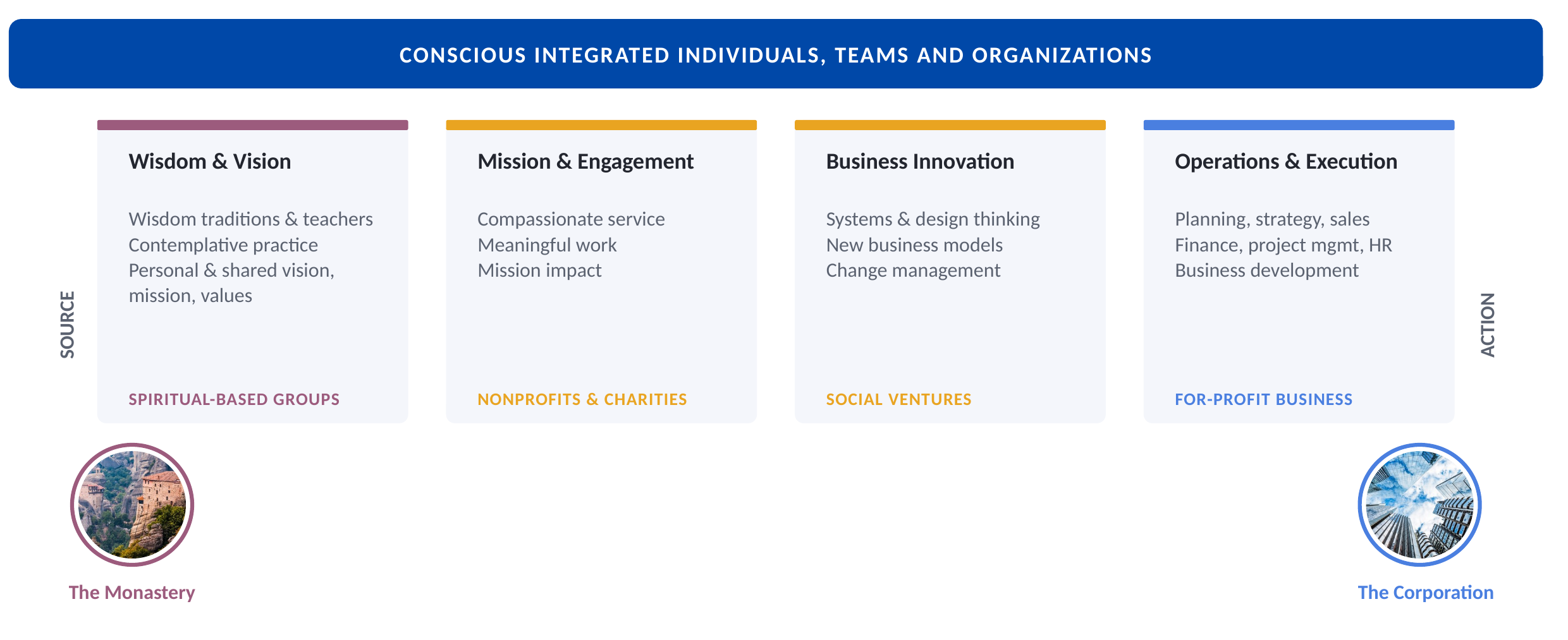
We've spent decades inside three very different worlds, and each gets something important right:
The nonprofit / social venture — strong mission focus, meaningful work, innovative models for doing good. But too often running on burnout and poverty mindsets.
The corporation — innovation-driven, action-oriented, functional and efficient. But working within a narrow quarterly-earnings paradigm that puts human wellbeing to one side.
The monastery — rooted in wisdom, contemplative practice, and a vision bigger than any one person. An unconventional model, and a proven one: old European monasteries and Tibetan temple complexes flourished as financially sustainable, values-led communities for centuries.
Put together, these describe a Conscious Integrated Organization — individuals, teams, and organizations operating with wisdom and compassion and functionality and effectiveness, not one traded off against the other.
Five Gateways to Growth
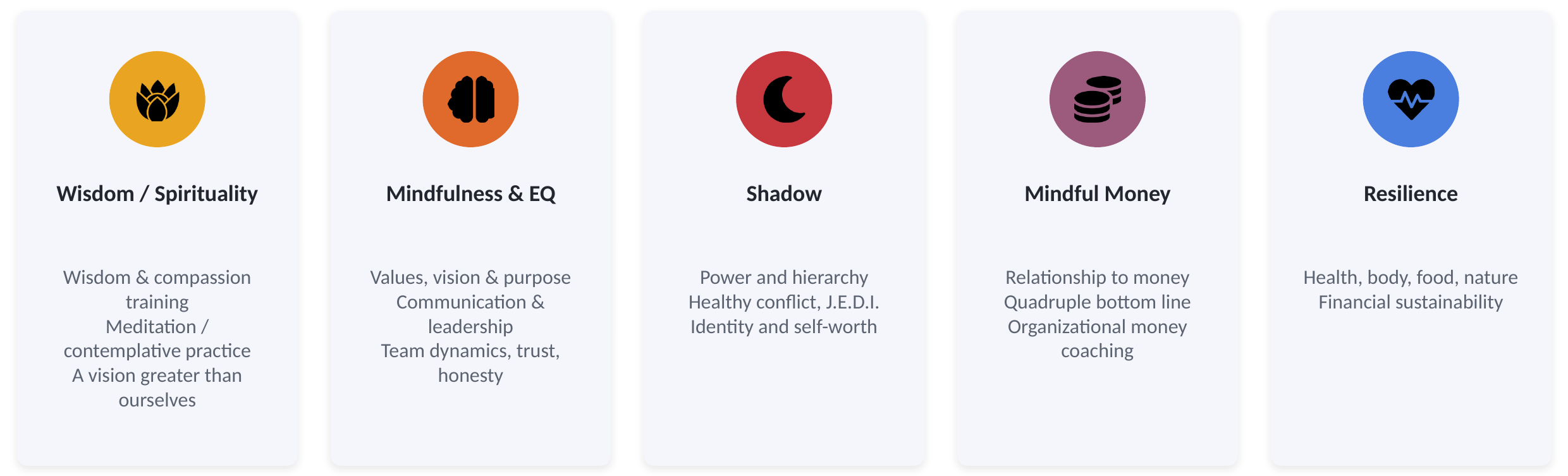
On the path toward becoming a conscious integrated organization — or individual — there are five recurring areas of growth. Which gateway you enter through first depends on where you're starting from.
Wisdom & Spirituality — a vision greater than ourselves
Mindfulness & EQ — values, communication, leadership
Shadow — power, hierarchy, healthy conflict
Mindful Money — our relationship to money, individually and organizationally
Resilience — health, sustainability, financial grounding
These aren't a checklist to work through once. Integrated into how you actually work, lead, and communicate, they're what make the shift lasting — a way of operating, not a program with an end date.
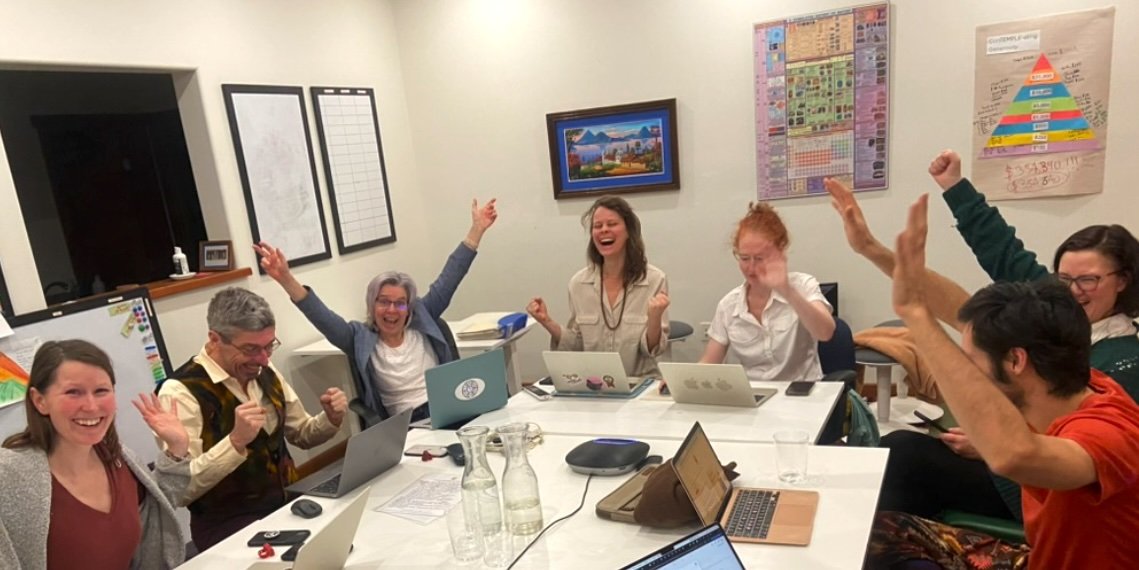
Money: the deepest lever
One thread runs through this work more than any other: an organization's relationship to money. Individually, all of us carry some kind of knot around money — and going into that knot leads into the bigger things: the shadow, our vision, our values, our priorities, our growth. The same is true at the organizational level. It's often the single most direct doorway into everything else.
Where this comes from
This isn't theory. For twenty years, Duncan Cryle was part of Clear Sky Retreat Center's organizational leadership in the Canadian Rockies, In parallel he has twenty years in technology leadership at IBM and SS&C Technologies, co-creating extensive mindfulness programs at both. He has also worked consulting with boards and nonprofits. It's a rare vantage point spanning the spiritual world, the nonprofit world, and the business world. The model is drawn and tested from over twenty years of real-life organizational experience. Find out more about Duncan here, and our network of partners.